The Specialized Master in Public Policies and Strategies for the Environment - SpM PPSE - was created in 2010. The content of the course has since been adapted to the changing context of environmental action.
This training aims to meet the need for high-level professionals to strengthen the environmental effectiveness of policies, plans and projects carried out by public and private actors for the ecological transition.
Due to the importance of legislation and regulation, the environmental fields are structured, for a large part, by public policies. Developing the skills to know and understand the making of public action and the stakes of its implementation is therefore necessary to act for the environment.
The SpM PPSE has been connected since its inception to the training of senior civil servants (Ingénieurs des Ponts des Eaux et des Forêts) within the SpM "Policies and Public Action for Sustainable Development" (SpM PAPDD). Some training modules are shared (those that enable the acquisition of skills in the field of negotiation for the environment and the design and use of prospective approaches for the environment). The SpM PPSE also occasionally welcomes students who are civil servants and territorial civil servants and who may ask to be integrated into the SM PPSE in view of their needs in terms of skills.
Beyond the technical skills of the "sustainable development" or environmental professions, being able to respond to the challenges of the ecological transition implies acquiring or reinforcing strategic skills (analysis and strategic management of complex situations, negotiation, consultation, analysis of the games and strategies of actors, ability to untangle controversies, coordination between professions and between sectors, change management). Moreover, behind an apparent diversity of themes structured into distinct professional fields, the subjects dealt with (biodiversity, water, agriculture, energy, food, climate, air, transport, urban planning, waste, etc.) are highly interdependent. Explicitly managing this interdependence is a prerequisite for effective environmental action. Being able to move away from sectoral logics is indeed necessary to lead the ecological transition and integrate the challenges of adaptation to global changes.
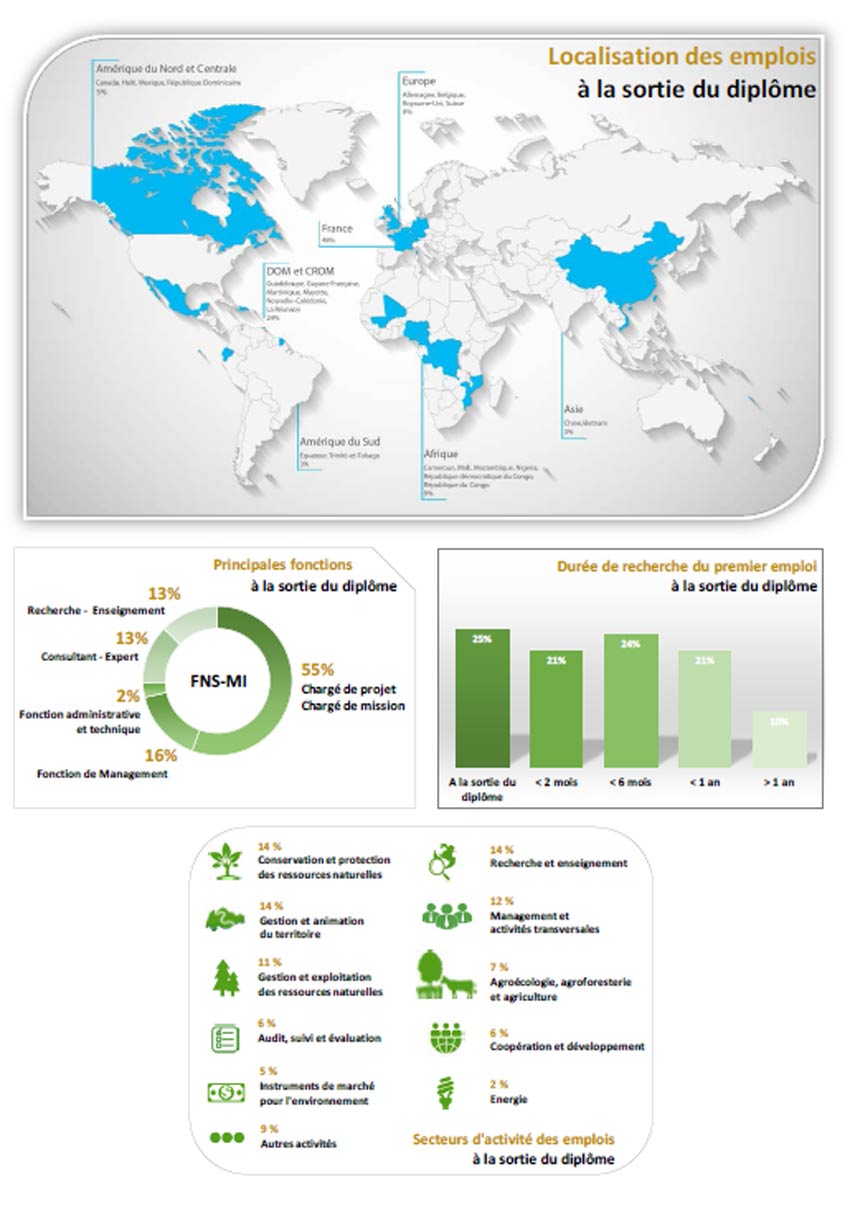
The objective of the SpM PPSE is to provide professionals with diverse backgrounds (engineers, doctors and holders of a Master's degree in the field of environmental sciences such as ecology, physics or biology and social sciences, in particular political science) with a dual skill set as an expert in the analysis, management and evaluation of strategic action for the environment. In further study, it allows students to strengthen their employability in the environment, sustainable development and ecological transition professions.
The SpM PPSE welcomes both people involved in a professional reconversion project and those continuing their studies.
The course focuses on the ecological transition and addresses environmental issues such as
- The preservation of biodiversity (terrestrial and marine)
- Energy transition
- Mitigation and adaptation to climate change;
- Environmental public services (circular economy and sobriety, drinking water supply/sanitation, agro-ecological and food transition, sustainable mobility, urban planning and ecological transition, air quality...)
- Use of natural resources and territorial ecological transition.