

Become an expert in analysis and management of strategic environmental action
The environment is a field where public action is structuring, whether it is through the framework of standards, the obligation to prevent damage, the study of effects or the associated public services (water or waste for example). The SpM PPSE provides expertise in the world of the environment and the strategic skills needed to become expert in analysis and management of strategic environmental action.
Practical informations
Applications for the SpM PPSE 2023-2024 are closed
Registration fees and charges
The registration fees for 2023/2024 are divided as follows according to the financing status
- Employee or self-employed with training costs covered by a public or private funder: 10 000 euros
- Jobseeker with full coverage of training costs by a third party: 9 000 euros
- Other statuses: 8 000 euros
They include travel expenses during the training (field trips, modules and projects) and the cost of the training as a whole.
Teaching languages
French almost exclusively.
Selection process
The selection process begins with an examination of the application by the eligibility panel.
A Master's degree, or an engineering degree, or a degree from a business school is required, or, failing that, an M1 followed by three years of professional experience.
If the candidate is declared eligible, he/she is invited to an admission interview with a jury composed of members of the SpM PPSE teaching team. This interview takes place in Paris or, if the candidate is far away, by audiovisual means. Final admissions are decided by the jury on several occasions between April and July.
Applicants for external funding must submit their application to the SpM PPSE early enough to allow the jury to make a decision within a timeframe compatible with the deadlines of their application for external funding.
Logistics
All the teaching modules take place in Paris, at the AgroParisTech Campus, 19 avenue du Maine, corresponding to approximately 100 days of training at the centre and 33 days of projects and field studies.
To find out about other AgroParisTech Specialized Masters courses
Visit the page of AgroParisTech Specialized Masters.
Background and aims
The Specialized Master in Public Policies and Strategies for the Environment - SpM PPSE - was created in 2010. The content of the course has since been adapted to the changing context of environmental action.
This training aims to meet the need for high-level professionals to strengthen the environmental effectiveness of policies, plans and projects carried out by public and private actors for the ecological transition.
Due to the importance of legislation and regulation, the environmental fields are structured, for a large part, by public policies. Developing the skills to know and understand the making of public action and the stakes of its implementation is therefore necessary to act for the environment.
The SpM PPSE has been connected since its inception to the training of senior civil servants (Ingénieurs des Ponts des Eaux et des Forêts) within the SpM "Policies and Public Action for Sustainable Development" (SpM PAPDD). Some training modules are shared (those that enable the acquisition of skills in the field of negotiation for the environment and the design and use of prospective approaches for the environment). The SpM PPSE also occasionally welcomes students who are civil servants and territorial civil servants and who may ask to be integrated into the SM PPSE in view of their needs in terms of skills.
Beyond the technical skills of the "sustainable development" or environmental professions, being able to respond to the challenges of the ecological transition implies acquiring or reinforcing strategic skills (analysis and strategic management of complex situations, negotiation, consultation, analysis of the games and strategies of actors, ability to untangle controversies, coordination between professions and between sectors, change management). Moreover, behind an apparent diversity of themes structured into distinct professional fields, the subjects dealt with (biodiversity, water, agriculture, energy, food, climate, air, transport, urban planning, waste, etc.) are highly interdependent. Explicitly managing this interdependence is a prerequisite for effective environmental action. Being able to move away from sectoral logics is indeed necessary to lead the ecological transition and integrate the challenges of adaptation to global changes.
The objective of the SpM PPSE is to provide professionals with diverse backgrounds (engineers, doctors and holders of a Master's degree in the field of environmental sciences such as ecology, physics or biology and social sciences, in particular political science) with a dual skill set as an expert in the analysis, management and evaluation of strategic action for the environment. In further study, it allows students to strengthen their employability in the environment, sustainable development and ecological transition professions.
The SpM PPSE welcomes both people involved in a professional reconversion project and those continuing their studies.
The course focuses on the ecological transition and addresses environmental issues such as
- The preservation of biodiversity (terrestrial and marine)
- Energy transition
- Mitigation and adaptation to climate change;
- Environmental public services (circular economy and sobriety, drinking water supply/sanitation, agro-ecological and food transition, sustainable mobility, urban planning and ecological transition, air quality...)
- Use of natural resources and territorial ecological transition.
Core training and skills
In addition to an in-depth knowledge of environmental issues, associated public policies, stakeholders and their logic of action, SpM PPSE auditors acquire the skills to :
- Conduct a strategic analysis to act for the ecological transition
- Carry out studies and diagnoses for the implementation of projects, plans, programmes or policies for the ecological transition
- Evaluate the implementation of public action for the ecological transition in order to understand and anticipate its evolution at national and international levels
- Manage consultation mechanisms and unravel environmental controversies.
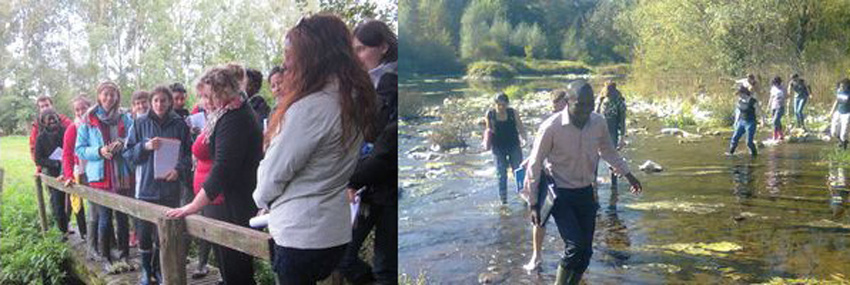
The active pedagogy makes a large place for fieldwork and study trips. It aims to promote learning. Professional skills are thus acquired and put into practice throughout the so-called "academic" phase of the training (from September to March) and the professional mission (lasting at least 5 months). They are used in the various strategic functions that the auditors are required to occupy after their graduation to design, negotiate, plead, consult, lead and evaluate actions, projects, plans or policies for the ecological transition in complex situations.
Target groups
The SpM PPSE is accessible to holders of a master's degree (graduates of an engineering school, a university master's degree, a management school) who are continuing their studies or returning to school after having worked. The vast majority of courses are taught in French.
The diversity of the auditors is favoured, in particular by :
- the recruitment of graduates from various engineering, management or master's degree courses, and of professionals wishing to improve and broaden their skills;
- opening up to students from countries where environmental issues are important or to international students attracted by French skills in the sector;
- the reciprocal valorisation of acquired knowledge and the encouragement of the exchange of knowledge and know-how.
Course organisation
The programme is composed of :
1- Teaching modules that combine theoretical contributions, knowledge acquisition, analysis of concrete cases, and the implementation of projects that promote learning. More than 30% of the SpM PPSE lecturers are professionals working in the professions covered by the course. These modules take place from the beginning of September to mid-March.
2- A project conducted throughout the first semester, from the Field to the Environmental File (TDE). Beyond the disciplinary and academic teachings anchored in professional practice, the SpM PPSE is based on more interactive exercises: field trips, study tours, local surveys, case studies. For example, in 2020-2021, the TDE focused on 4 case studies around the implementation of the ecological transition and adaptation to climate change in the Deux-Sèvres department. The following four topics were addressed: (1) the implementation of the energy transition in the department of Deux-Sèvres; (2) the maintenance of the bocage for the agro-ecological transition; (3) the recovery of water quality through the management of pollution, particularly of agricultural origin in the department of Deux-Sèvres; (4) the environmental added value provided by the creation of the PNR de Gâtine Poitevine
3- A professional mission in a structure that supports environmental projects or objectives, during the second semester (from mid-March to mid-September). This will lead to the oral defense of a professional thesis. Within the host organisation, the auditor carries out an operational mission. By mobilising the theoretical and methodological frameworks acquired during the academic period, he/she structures an environmental issue through his/her professional thesis and develops elements of strategy enabling the host organisation to progress in the implementation of its environmental objectives.
4 - From personalised support to a professional project
The teaching team and partners
Researchers and trainers from different disciplines, from AgroParisTech and other institutions, as well as young associate researchers are involved throughout the training programme.
The SpM PPSE also relies on professional partners associated with this training, through their interventions in the modules, through the files that they will propose to the students and through their interest in the orientations of this training.
Employment opportunities
The holder of the Specialized Master in "Public Policies and Strategies for the Environment" is an expert in the analysis and management of strategic action for the environment. As a high-level professional, he or she is responsible for the design, negotiation, consultation, implementation and strategic evaluation of policies, plans or projects for the ecological transition in various professions and functions.
The progression of his or her career path leads him or her to occupy, initially, the following functions
- Project manager or junior or senior consultant (in environment, evaluation, climate and energy, bio-waste, polluted soils, sustainable development, ecological transition, consultation) in a consultancy firm or a specialised research office
- Project manager (in energy, biodiversity, climate, energy, land strategy, etc.) in the departments of a local authority, a ministry or a public institution.
- Environmental officer in a company.
- Environmental lobbyist in an organisation or professional union
- Employee in the social economy sector in charge of developing environmental projects (waste prevention, circular economy, fight against waste...)
Two years or more after obtaining the diploma, as a senior manager, he/she carries out the functions of manager which precede or correspond to the senior functions of :
- Project manager, mission director, in a consulting firm or a design office
- Founding member of a consultancy or specialised consultancy firm.
- Senior consultant or expert on an environmental theme, independent or in a consultancy firm
- Public policy officer in a foundation for scientific cooperation.
- Prefigurator of a biodiversity agency within a local authority
- Head of department in the decentralised services of a ministry
- Environmental manager in a large company
- Head of department in a professional organisation
- Partnership officer in an environmental NGO
Graduates of the SpM PPSE work almost equally in the public and voluntary sectors and in private organisations.
Since its creation, the course has facilitated access to jobs in the fields of advocacy and pro-environmental lobbying (within environmental non-governmental organisations).
The progression of his or her career path leads him or her to occupy, initially, the following functions
- Project manager or junior or senior consultant (in environment, evaluation, climate and energy, bio-waste, polluted soils, sustainable development, ecological transition, consultation) in a consultancy firm or a specialised research office
- Project manager (in energy, biodiversity, climate, energy, land strategy, etc.) in the departments of a local authority, a ministry or a public institution.
- Environmental officer in a company.
- Environmental lobbyist in an organisation or professional union
- Employee in the social economy sector in charge of developing environmental projects (waste prevention, circular economy, fight against waste...)
Two years or more after obtaining the diploma, as a senior manager, he/she carries out the functions of manager which precede or correspond to the senior functions of :
- Project manager, mission director, in a consulting firm or a design office
- Founding member of a consultancy or specialised consultancy firm.
- Senior consultant or expert on an environmental theme, independent or in a consultancy firm
- Public policy officer in a foundation for scientific cooperation.
- Prefigurator of a biodiversity agency within a local authority
- Head of department in the decentralised services of a ministry
- Environmental manager in a large company
- Head of department in a professional organisation
- Partnership officer in an environmental NGO
Graduates of the SpM PPSE work almost equally in the public and voluntary sectors and in private organisations.
Since its creation, the course has facilitated access to jobs in the fields of advocacy and pro-environmental lobbying (within environmental non-governmental organisations).